Saturday, March 5, 2011

The Jewish Cemetery (Židovský hřbitov), Hluboka, Czech Republic

In our continuing visits to Jewish Cemeteries (Židovský hřbitov) of the Czech Republic with our colleague Lynn, we offer another set of landscape views: this one tucked beneath the Castle Hill in Hluboka (just a few km away from us).
Of all the cemeteries we have seen to date, this was the first one with the gates unlocked and ajar!

 Most do not have much, if any, signage. This one in Czech, English and German explains a bit about the history:
Once inside the gate, some of the old stones are still present, although most were broken off during the Nazi occupation and had to be righted again later. On the right-hand side, however, are all newer stones which means that all of them were destroyed by the Nazis. It is a sad, quiet place here.....even somewhat eerie in feeling.
Here are a few views of some of the old stones, many dating back to the 1700s and 1800s.

You can see that only a few of the old stones remain but it is a wonder that any do. Here a colorful mixture of stone markers.
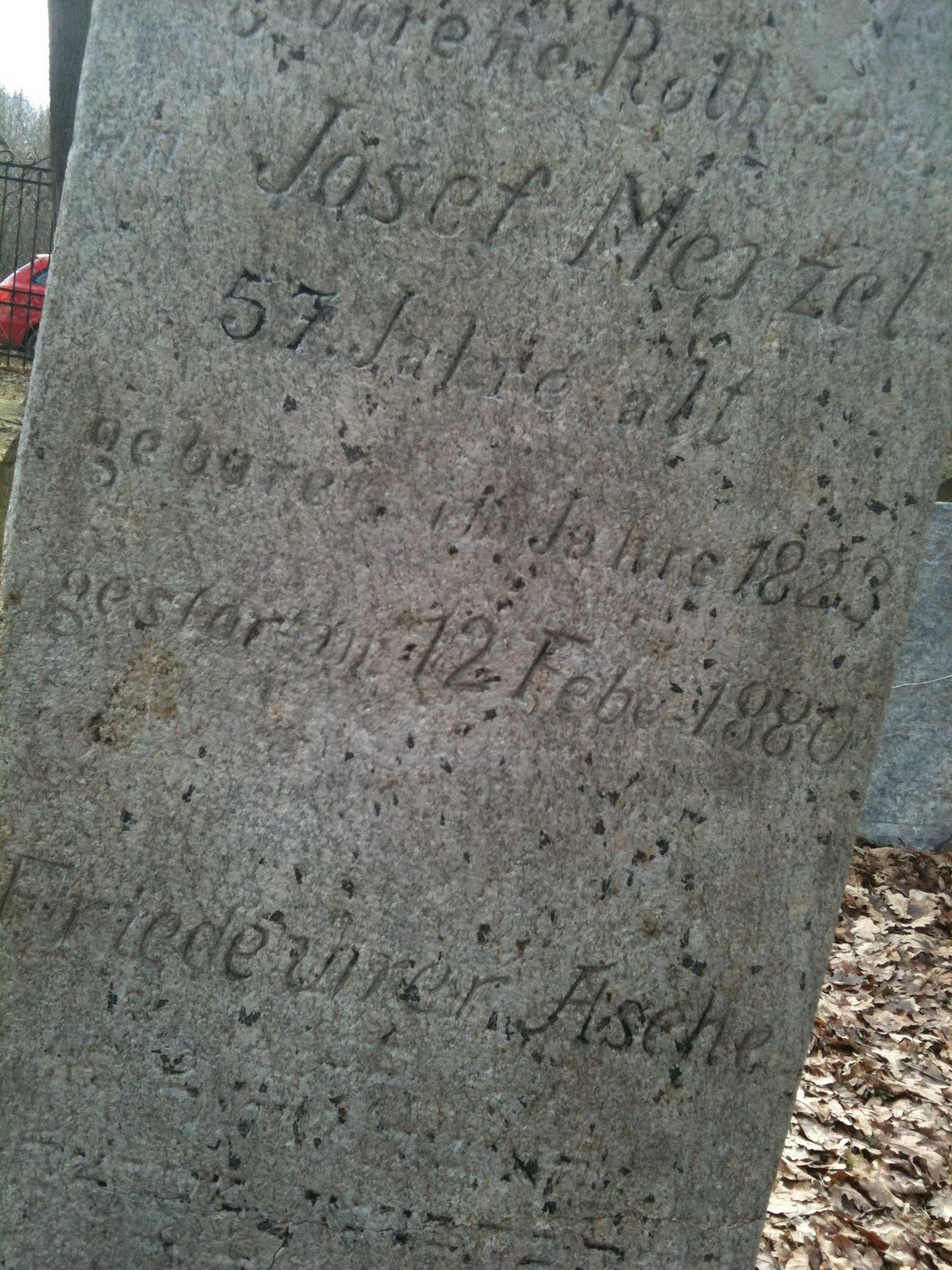
This one, for Josef Menzel, is dated 1883 and another date for 1880.

Many of the stones in this grouping are damaged, either by recent vandals or from years ago. Regardless,  the sharp edges jar our senses.
Now, interestingly enough, some of these had tags around the stone....string tied with a piece of blue material. Each one had a number on them. We figure most likely someone is mapping the cemetery for the grave locations.
Mark holds a couple of the tags:
 
As with so many other Jewish cemeteries we have visited, this one is lined with oak trees within the walls and, again, numerous mature specimens of ivy, Hedera helix, climbing the trees. The color green is everywhere even in the depths of winter. Green and chartreuse lichen grace the stones and the base of the tree trunks.
Here, a small black bird scratches looking for bugs beneath the bases of the huge oak trees festooned with green lichens. This bird was extremely tame....we walked right up to it and it did not fly away! We watched it for several minutes.
The old walls seem greyed and sadly quiet while across the street the local Benzina (petrol or gas) station is bustling with activity. Numerous cars and trucks roar past on the road or stop at the Benzina. No one looks over here...it's like nothing exists.

Our friend Lynn takes here photos of the station and our red Skoda. Someday everyone will get to see her images when she opens her shows on the Czech Jewish cemeteries. We can hardly wait!
We are surprised to see several wrought iron grave markers which bear the Rzmberk seal (the rose). As we had suspected, some members of the Rzmberk family must have had Jewish connections.
Neil, sporting his hat from his home town's store, Dan & Whits, of Norwich Vermont (USA) wants to look at the numerous stones graced with the juvenile (immature) growth of ivy.
Some markers are completely covered with ivy while others stand starkly against the cloudy sky completely without it.
This one is artfully covered with drapes of ivy...keeping the mystery of the unknown stories of the many people buried here just that:  most of it hidden and unknown.
These two are completely covered....now green and living forms. From death to rebirth; a newness and richness arises.
Occasionally we see a stone carefully placed on top of a grave marker, carefully balanced in time. This is a common Jewish tradition of a more permanent remembrance from the living. They outlive fresh flowers and certainly speak so much more than plastic ones.
Behind the cemetery, a road leads around the adjacent historic Fish Pond where many people walk or bike by in complete silence. 
We see their heads bobbing above the cemetery wall when we're inside.
Here are a few pictures of the frozen historic Fish Pond this wintery day. The naked oak branches seem to scrub the ice clear of snows.


To the north of the cemetery, a vast empty space exists with only some moss and lichen-covered oak trees sprout. This most likely is the extra space for cemetery expansion or....perhaps, it was an older section of the cemetery that has now completely disappeared?


It is a most interesting place to visit, this Jewish Cemetery or Židovský hřbitov. We leave, immensely touched and changed forever by the common threads of green, old and new, things here, others forgotten. May we all grasp the threads of remembrance for in here we find the pulse of life eternal.
Disclaimer: This blog is not an official University of Minnesota or Fulbright Program blog. The views expressed are my own and not those of the Fulbright Program, the U.S. Department of State or any of its partner organizations, or the University of Minnesota.

Hluboka Castle revisited

On 25 December we posted winter viewings of the Hluboka Castle, Hluboka, Czech Republic.
This past month we visited it again, having lunch in the Conservatory (we brought our own picnic, of course), after spending the morning photographing the Jewish Cemetery located nearby.
By chance, the inner courtyard of the Castle was open for visitors. Here are pictures  of what we saw...remember this was once the fall/early winter 'Hunting Cabin' when the Schwarzenbergs owned it!

We enter the courtyard...a grand place for entertaining and concerts, don't you think?
 But, when you start gazing at the walls, we were amazed to see endless arrays of antlers from previous hunting expeditions displayed everywhere.....outside!

 Up and down every wall were numerous antlers, each with the date the animal was killed and, sometimes, the name of the hunter.

 We could peer inside the glass doors of the main entrance to the courtyard and see parts of the foyer and grand staircase inside:
 (these are our head shadows which frame the pictures!).
 Later, we will return to see the spring flowers in the gardens as well as more of the interior views....stay tuned!


Disclaimer: This blog is not an official University of Minnesota or Fulbright Program blog. The views expressed are my own and not those of the Fulbright Program, the U.S. Department of State or any of its partner organizations, or the University of Minnesota.

Thursday, March 3, 2011

Portends of spring in Plastovice: Winter aconite in flower!

As we visited our colleagues in Plastovice (see last July's posting about the town), we were so delighted to see these in flower. They are the portends of spring...the first spring flowering plants in this region.

These are called Eranthis hyemalis L. (=Eranthis hiemalis) or Winter Aconite and are in the Buttercup family (the Ranunculaceae). Here are the semi-raised beds where they are growing in the gardens of these horticulturists:
 For those of you who are still staring at immense amounts of snow, remember that spring will soon be here. Days are getting longer and the angle of the sun is rising in the sky...sure signs of doom for snow at lower elevations.

Be cheered by Winter Aconite!


Disclaimer: This blog is not an official University of Minnesota or Fulbright Program blog. The views expressed are my own and not those of the Fulbright Program, the U.S. Department of State or any of its partner organizations, or the University of Minnesota.

Wednesday, March 2, 2011

The Jewish Cemetery (Židovský hřbitov), Jindřichův Hradec, Czech Republic

We have been visiting Jewish Cemeteries (Židovský hřbitov) along with our Fulbright colleague, Lynn. Thus far, we have visited ones locally in Southern Bohemia (see previous posting on the Trebon cemetery), taking the time to soak up the atmosphere, see as much as we can (often they are tightly locked), and wonder about the perceptions of the nearly decimated Jewish population in the Czech Republic (now numbering only ~5,000).
Occasionally Neil may write a poem about the experience.
We have found these fascinating, local tributes which speak so resoundingly of the horrors of WWII, the destruction of these cemeteries, their rebuilding (often by American Jews), and posting of as many new cemetery markers as possible. What is particularly fascinating and peculiar is that, despite most cemeteries having impressive surrounding walls, they are often overlooked and not 'seen'. Only the older generation remembers the horrors of the German invasion while the younger generation may not even know anything about what these cemeteries represent in their past. We will continue to offer postings on these sites as we visit them, as stark reminders of the inhumanity our species is capable of towards those that become 'scapegoats' and targets.

Each city or settlement usually has at least a Jewish cemetery and may also have a former Synagogue which are now either residences or a Hussite Church. We posted pictures of the former Synagogue in Třeboň which is now a residence. That building still bears the marks of its original purpose, particularly the white and blue colors on the exterior.

Visit to the Jewish Cemetery (Židovský hřbitov), Jindřichův Hradec, Czech Republic

This past Sunday we visited the Jewish Cemetery in Jindřichův Hradec, a famous city east of Třeboň, which was once the economic center of Europe (see our earlier postings on the castle and Roundel we visited last summer). The cemetery dates back to ~1400 and was surrounded by walls in the 1770s. It is positioned on Pejčoch Hill above the quiet River Nežárka.

It is now surrounded with Soviet-era multistoried flats.

The meeting house still has the Star of David on it but the buildings are now a Hussite Church and a family lives in another one. The gates are only accessible through the Hussite complex. 
Otherwise, it is simply walls which we walked around and peered over to see the very unique terraced cemetery, stair-stepping up from the river to the top of the hill.

This sign posting says (roughly translated): Allowed to enter private property! Attention! Cemetery guarding camera.

The stones vary in age, with the earliest legible one dating to 1714. Most of the headstones were destroyed by the Nazis and have been recently replaced after WWII.

 
Commonly, most cemeteries are tree-lined and filled with perennial ivy, Hedera helix...vestiges of past plantings of ornamentals within each one. Here the ivy has jumped over the wall and started spreading throughout the trees and forest floor.
On the other end of the cemetery, it was lined with larches, Larix, which is also very unusual.
This end of the cemetery was lined with white birch, Betula, which were clothed in ivy.

As with all other rebuilt Jewish cemeteries that we visited, this one was moving in very different ways on this cold, snowy day. We offer this poem which encapsulates what we experienced. Join us for quiet reflection on past and current perceptions of this sacred place.

Overlooking
(on a visit to the hillside Jewish Cemetery, Jindřichův Hradec, Czech Republic)
24 Feb. 2011

Neil O. Anderson
© 2011

As we park
our Skoda,
a blind man and his dog
bark out
greetings.
We freeze inside.
Will they see us?
Aged redhead turns;
whitened canine nostrils’ sensing.
As they pass,
we emerge.
Hellos exchange:
Dobrý den,
dobre pes.
We see
and
are seen.


Lynn, heavy with tripod,
vanishes over hill,
sliding towards Nežárka River,
past terraced gravestones,
climbing to overlook us
at curbside.


Mark and I depart from wheelchair,
meander along
where wall
drops in height at hillcrest.


 Ivy entombs stately birches
with gentleness that ascends the wall
and holds us fast
to carpet the woods
in eternal green.
We lean as frost-heaved tombstones
against the wall,
letting chartreuse lichens
on our northern sides
grow.

Up here,
on Pejčoch Hill,
greyed concrete
of jarring Soviet lines
form windowed flats—
balcony vistas lined with red—
gone old of Bohemian coal soot years—
in each,
the windowed view
curtains elderly,
tucked sheer and thin,
we are closely watched.


We are seen.
And yet,
cemetery, walls
are not—in view.
Overlooked.


Over again,
repeatedly in walking us ‘round,
he who in blindness with dog—
sees,
relooks,
we are here.

“How”, you ask,
“do eyes that see
overlook
these walls?”


We the River Nežárka
on our way
in silence,
disappear.


Disclaimer: This blog is not an official University of Minnesota or Fulbright Program blog. The views expressed are my own and not those of the Fulbright Program, the U.S. Department of State or any of its partner organizations, or the University of Minnesota.